Building a Real Estate Platform That Puts Trust First.
The Indian real estate listing market is broken. Not in a subtle, "could be better" way — broken in a way that costs buyers thousands of hours, sellers thousands of leads, and agents thousands of rupees in wasted ad spend.
The dominant platforms — the ones processing millions of listings — have a structural problem: their business model rewards volume over quality. More listings means more traffic. More traffic means more lead inquiries. More leads means they can charge agents per-lead or sell premium listing placements. The incentive is to have more listings, not better ones.
The result? A marketplace full of duplicate listings, outdated properties, fake photos, inflated pricing, and "verified" badges that mean nothing. Buyers learn to distrust every listing. Sellers compete with ghost properties. Agents pay for leads that have already been sold to four other brokers.
MetroMitti was built to break that cycle.
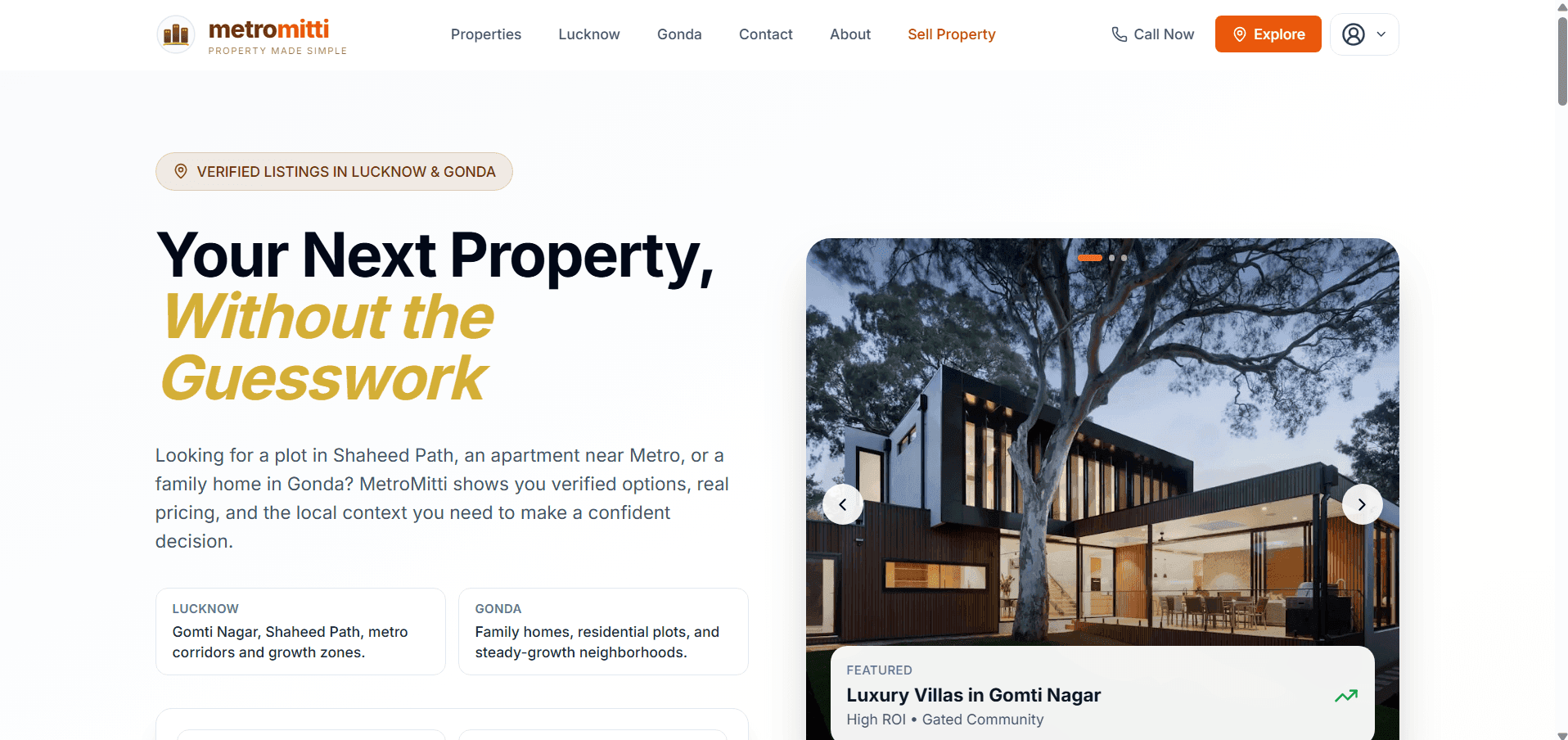
Not by being bigger. By being better — verified listings only, clean UX, direct lead flow, and an admin-controlled ecosystem that prioritizes trust over volume.
Sparq IT Services designed and built the entire platform from the ground up.
The Problem in the Market
Before building, we studied what's broken — and why buyers, sellers, and agents are all frustrated with the status quo.
For Buyers
- Fake and duplicate listings everywhere. The same property appears 5 times from different brokers with different prices. Half the listings on major platforms are either outdated, misrepresented, or complete fabrications designed to generate phone calls.
- Overwhelmed by noise. Cluttered interfaces, aggressive popups, auto-dialer calls the moment you show interest, and "recommendations" that are actually paid placements. The user experience is designed to extract contact information, not help people find homes.
- Zero transparency on pricing. Listed prices rarely reflect reality. "Contact for price" is code for "we'll tell you what you want to hear to get a site visit." Buyers waste time on properties that are 30% above their actual budget.
For Sellers & Agents
- Leads are resold. On most platforms, when a buyer inquires about a property, that lead isn't exclusive. It's sold to 3-5 agents simultaneously. The result: a race to the phone where the fastest caller wins, regardless of quality or relevance.
- Pay-to-play visibility. Organic listing visibility is throttled. To get seen, sellers and agents pay for "premium" or "featured" placements — essentially buying their own leads back on a platform that should be connecting them for free.
- No control over listing quality. Anyone can list anything. There's no verification workflow, no moderation, no quality threshold. This dilutes legitimate listings with spam, hurting serious sellers and agents who maintain accurate information.
The Core Structural Problem
Traditional platforms are lead-selling businesses disguised as listing platforms. Their incentive is to maximize the number of inquiries (which they monetize), not to facilitate genuine buyer-seller connections. Everything — the UX, the listing rules, the monetization — is optimized for lead volume, not transaction quality.
MetroMitti was designed with a fundamentally different premise: the platform should facilitate trust, not traffic.
The Vision Behind MetroMitti
MetroMitti isn't trying to be "another 99acres." It's built on four principles that directly counter the structural problems above:
1. Verified Listings Only
Every property on MetroMitti goes through an admin approval workflow before it appears on the platform. No auto-publishing, no unmoderated uploads. This means fewer listings — but every listing a buyer sees is real, current, and accurately represented. Quality over quantity.
2. Clean, Focused UX
The interface is deliberately stripped of the clutter that plagues incumbent platforms. No aggressive popups, no autoplaying video ads, no "similar properties" feeds designed to distract. The design philosophy: help the buyer find the right property fast, then get out of the way.
3. Direct Lead Flow
When a buyer inquires about a property, that lead goes directly to the listing owner or assigned agent — and only to them. No lead reselling. No sharing with competing brokers. The platform facilitates a direct connection between buyer interest and the person responsible for the property. This is the single biggest trust differentiator.
4. Admin-Controlled Ecosystem
Unlike open marketplace models where anyone can list anything, MetroMitti operates a controlled ecosystem. Admins moderate listings, manage agents, and maintain platform quality. This trade-off — slower growth for higher trust — is intentional. The platform's reputation depends on every listing being legitimate.
Solution & Platform Architecture
We built MetroMitti as a modern, full-stack web application — architectured for the workflows real estate platforms actually need, not what a generic CMS can approximate.
Platform Structure
The platform serves three distinct user types, each with different access levels and capabilities:
Buyers (Public Users) The public-facing experience is designed for discovery and conversion. Property search, detailed listing pages with gallery and specifications, neighborhood context, and a clear path to inquire. No account required to browse — the platform earns contact information through value, not friction.
Individual Sellers Individual property owners can create an account and list one property on the platform. This deliberate limitation prevents spam listings and ensures that individual sellers are genuine — they have one property to sell, not a database of speculative listings. The single-listing constraint is a trust signal baked into the product architecture.
Channel Partners / Agents Verified agents and channel partners can list multiple properties under their profile. This tier is designed for real estate professionals who manage multiple mandates. Agent accounts are vetted — they don't self-serve into multi-listing access. This creates a credentialed layer of supply on the platform.
Property Approval Workflow
This is the mechanism that keeps the platform clean. Unlike open marketplaces where a listing goes live the moment it's submitted:
- Submission — Seller or agent creates a listing with property details, photos, pricing, and location.
- Admin Review — The listing enters a moderation queue. An admin reviews the details for accuracy, completeness, and legitimacy. Are the photos real? Does the pricing match the micro-market? Are the specifications plausible?
- Approval or Rejection — Approved listings go live on the platform. Rejected listings get feedback on what needs correction. No listing bypasses this step.
This workflow is the backbone of platform trust. Every property a buyer sees has been vetted. That's the promise — and the architecture enforces it.
Key Features & Functionalities
Property Listings & Discovery
- 12+ verified properties live at launch — each admin-approved and accurately represented
- Detailed listing pages with structured property data: configuration, area, price, floor, facing, amenities, furnishing status, and possession timeline
- Property gallery with final-slide CTA — the image carousel ends with a contact form slide, converting browsing intent into an inquiry at the peak engagement moment
- Clean search and filter interface — location, budget range, property type, BHK configuration. No clutter, no distraction. The filters serve the buyer, not the platform's ad inventory
- Mobile-first responsive design — the majority of property searches happen on phones. Every interaction is optimized for thumb navigation and mobile viewports
Admin Dashboard
The admin system is where MetroMitti's controlled-ecosystem philosophy becomes operational.
Role-Based Access:
- Super Admin — Full platform control. User management, agent verification, system configuration, and override capability across all modules.
- Admin — Operational access. Property moderation, lead management, and agent support. Can approve or reject listings, manage incoming leads, and handle day-to-day platform operations.
Property Moderation System:
- Centralized queue of all submitted listings
- Review interface showing property details, photos, and seller/agent information
- Approve, reject, or request changes — with the ability to add notes to the listing owner
- Status tracking across all listings: pending, approved, live, rejected, expired
Lead Management:
- Every inquiry captured with buyer details, property of interest, and timestamp
- Lead assignment tied to the specific listing owner or agent
- Status tracking from new inquiry through to follow-up
- No lead is shared or resold — direct routing only
Agent Management:
- Agent profiles with verification status
- Multi-listing capability for approved channel partners
- Performance visibility — listings active, leads received
- Ability to suspend or deactivate agent accounts that don't meet platform standards
Communication System
Resend API Integration:
- Automated email notifications on every form submission — the listing owner or agent is alerted the moment a buyer inquires
- Buyer confirmation emails — "Your inquiry has been received. The property owner will contact you directly."
- Admin notifications for new listing submissions entering the moderation queue
- Transactional reliability — no leads lost to spam filters or delayed delivery
Technology Stack
The stack was chosen for three priorities: speed, scalability, and maintainability.
- Frontend: Next.js (App Router) — server-rendered for SEO, fast for users, component-based architecture for rapid iteration
- Hosting: Vercel — edge deployment, sub-2-second loads, automatic scaling during traffic spikes
- Backend & Database: Supabase (PostgreSQL + Auth + Row-Level Security) — structured data, secure access control, real-time capabilities
- Email Automation: Resend API — transactional emails for lead notifications, buyer confirmations, and admin alerts
- Analytics: Google Tag Manager + Google Analytics 4 — full event tracking through a managed GTM container
- Ads Tracking: Meta Pixel — conversion events configured for retargeting and campaign optimization
- Admin UI: Custom-built dashboard — clean, mobile-responsive, role-based access, no third-party CRM dependency
- Version Control: GitHub
Why This Stack
Every component was chosen with real estate platform requirements in mind:
Next.js + Vercel — Property listing pages need to be fast (buyers bounce from slow pages) and SEO-indexable (organic search is the highest-intent traffic source for real estate). Server-side rendering handles both. Vercel's edge network ensures that a buyer in Delhi and a buyer in Bangalore get the same sub-2-second experience.
Supabase — A real estate platform deals with structured, relational data (properties, users, agents, leads, moderation statuses). PostgreSQL handles this natively. Row-Level Security ensures that agents only see their own leads, admins see everything, and buyers can't access backend data. Auth handles the multi-role login requirement without a separate identity provider.
Resend — Real estate leads are time-sensitive. A buyer who inquires at 10pm expects a response by morning. Resend's delivery reliability ensures that notifications hit inboxes instantly — not hours later, not in spam.
Marketing & Tracking Setup
A platform without tracking is a platform without intelligence. MetroMitti was built with measurement infrastructure from the first deployment.
Google Tag Manager (GTM)
All tracking runs through a single GTM container — clean, maintainable, and modifiable without code deployments. As the platform scales and marketing experiments multiply, new tags can be added through GTM without touching the codebase.
Google Analytics 4 (GA4)
Full event tracking configured for the metrics that matter in real estate:
- Property views — which listings get the most attention, and from which traffic sources
- Inquiry form submissions — the primary conversion event. Tracked with property ID, location, and configuration data for analysis
- Gallery interactions — how deep into the image carousel do buyers go before inquiring (or leaving)?
- Search and filter usage — what are buyers looking for? Which configurations, locations, and budgets are most searched? This data directly informs which properties the platform should attract more of
- Scroll depth and engagement time — on individual listing pages, how far do buyers scroll? Do they read the full specifications? This reveals which page sections drive or kill conversion
Meta Pixel
Configured with conversion events mirroring the GA4 structure. This enables:
- Retargeting audiences — buyers who viewed specific properties but didn't inquire can be reached with targeted ads on Facebook and Instagram
- Lookalike audiences — based on users who did inquiry, Meta can find more people with similar demographics and behavior patterns
- Campaign optimization — when Meta Ads campaigns launch, the pixel has historical data to optimize against real conversions, not just traffic
Conversion Tracking Architecture
The tracking isn't just "installed" — it's designed for growth:
- Property inquiry is mapped as the primary conversion event across GA4, Meta Pixel, and future Google Ads integration
- Secondary events (property views, gallery completion, search interactions) feed the algorithm's understanding of high-intent behavior
- The system is ready for Google Ads conversion tracking the moment search campaigns launch — no "we need to set up tracking first" delay
UX & Conversion Strategy
MetroMitti's UX isn't just "clean design." Every interface decision is a conversion decision.
Property Gallery → CTA Funnel
The property image gallery is the highest-engagement element on any listing page. Buyers swipe through photos to evaluate the property visually. On MetroMitti, the final slide of the gallery is a contact form CTA.
Why this works: at the moment a buyer has viewed every available photo, they're at peak engagement — they've invested attention, they've evaluated the property visually, and they're making a decision. Placing the inquiry form at this exact moment captures intent when it's highest. It's not a popup interruption. It's a natural next step in the browsing flow.
Listing Page Structure
Each property page follows a conversion-optimized structure:
- Hero gallery — full-width images, swipeable, ending with CTA slide
- Key specs bar — price, configuration, area, floor, facing — the critical decision data, scannable in 3 seconds
- Property details — amenities, furnishing status, possession timeline, property age
- Location context — neighborhood, connectivity, nearby landmarks
- Inquiry form — structured capture (name, phone, email, message) positioned after the buyer has consumed enough information to be qualified
No clutter between these sections. No "similar properties" carousel designed to leak attention to other listings. No auto-dialer triggers. The page serves one property and one conversion goal.
Mobile-First Admin Experience
The admin dashboard isn't a desktop-only afterthought. It's built mobile-first — because property moderation, lead review, and agent management happen on the go, not just at a desk. Clean tables, tap-friendly actions, responsive layouts. An admin can approve a listing from their phone in 10 seconds.
SEO & Growth Readiness
On-Page SEO
- Unique meta titles and descriptions for every property listing, service page, and content page — programmatically generated from property data (location + configuration + price range) to target long-tail search queries
- Structured data markup — PropertyListing schema on property pages surfaces rich results in Google search (price, location, images)
- Clean URL structure — human-readable, location-based slugs that align with how people search:
/properties/2bhk-apartment-sector-50-noidainstead of/listing?id=47392 - Sitemap and indexing — XML sitemap generated and submitted, robots.txt configured, canonical tags on all pages to prevent duplicate content issues
Organic Growth Strategy
Real estate search is inherently high-intent. Someone searching "2 BHK flat in Sector 50 Noida" is actively looking to buy or rent. The SEO architecture is built to capture this intent:
- Each property listing is an indexable, SEO-optimized page targeting location + configuration keywords
- As the listing inventory grows, the platform's organic search footprint expands automatically — every new verified listing is a new keyword opportunity
- The content structure (detailed specs, location context, clean markup) gives Google the signals it needs to rank these pages
Paid Ads Readiness
The platform is built to support paid acquisition from Day 1:
- Google Ads: GTM conversion tracking ready. The moment search campaigns go live, Smart Bidding can optimize for actual property inquiries — not just clicks
- Meta Ads: Pixel data is already accumulating. Retargeting audiences are building passively from organic traffic. When paid campaigns launch, they'll have warm audiences and conversion data from the start
- Landing page quality: Property pages are fast, mobile-optimized, and conversion-focused — exactly what Google Ads Quality Score and Meta's ad relevance metrics reward with lower costs
Results & Current Status
MetroMitti is early-stage and production-ready. Here's what's live:
- 12+ verified properties listed — each admin-approved through the moderation workflow. The platform prioritizes listing quality from the start.
- Full admin dashboard operational — Super Admin and Admin roles active, property moderation running, lead pipeline visible, agent management functional.
- Lead capture system live — every inquiry is captured, stored, and triggers automated email notifications via Resend. No lead leakage.
- Complete tracking infrastructure configured — GTM + GA4 + Meta Pixel with event-based conversion tracking. Every property view, gallery interaction, and inquiry submission is measured.
- SEO foundation in place — on-page optimization, metadata, structured data, and indexing configured for organic growth as the listing inventory scales.
- Ads-ready architecture — the platform can support Google Ads and Meta Ads campaigns immediately, with clean conversion data from the first click.
- Mobile-first experience — responsive across all devices, from property browsing to admin moderation.
This is a platform built to scale — not a prototype. The architecture handles 10x the current listing volume without infrastructure changes. The admin system manages 100 agents as cleanly as it manages 5. The tracking system gets smarter with every visitor.
Future Roadmap
MetroMitti is production-ready today and architectured for what comes next:
AI-Powered Property Matching
Intelligent recommendation engine that learns from buyer search patterns, inquiry behavior, and preference signals — surfacing the most relevant properties before the buyer even searches. Not "similar properties" based on location alone, but genuine intent matching.
Automated Listing Verification
AI-assisted photo verification (detecting stock photos, duplicate images, and misrepresented interiors), price-range validation against micro-market data, and automated flagging of listing anomalies — making the approval workflow faster without compromising quality.
Agent Performance Analytics
Detailed dashboards for channel partners — lead conversion rates, response time metrics, buyer satisfaction signals. Agents who perform well get more visibility. The platform rewards quality, not just quantity.
Expanded Geography
The platform architecture supports multi-city expansion. Each market can maintain its own quality standards and moderation workflows while sharing the core platform infrastructure. Growth is controlled, not chaotic.
Buyer Profiles & Saved Searches
Persistent buyer accounts with saved searches, shortlisted properties, and notification preferences — turning one-time visitors into repeat users who engage with the platform throughout their buying journey.
The Key Takeaway
The real estate listing market doesn't need another platform with more listings. It needs a platform with better ones.
MetroMitti is built on a fundamentally different promise: every listing is verified, every lead is direct, and every interaction is designed to build trust — not extract data. The controlled ecosystem trades growth speed for growth quality. Fewer listings, but every one is real. Fewer leads, but every one goes to the right person. Less noise, more signal.
This isn't a marketplace play. It's a trust infrastructure play — and in a market where buyers have been trained to distrust every listing they see, trust is the most valuable product a platform can offer.
The foundation is live. The architecture is built to scale. The tracking is ready for growth. What comes next is volume — and it's coming on a platform that was built to handle it properly.
Want to build a scalable platform — not just a website? MetroMitti is what happens when product engineering meets market understanding. We don't build templates. We build systems with admin control, role-based access, moderation workflows, lead management, and the tracking infrastructure to scale.
Talk to Sparq IT Services — let's build the platform your market actually needs.