Building a Lead Engine for a Compliance Services Business.
Most certification bodies run on reputation, referrals, and PDFs emailed around in WhatsApp groups. TDSS Certification Services came to us wanting something different: a professional digital presence that could stand alongside the tier-one certification names, capture leads structured enough for a proper sales process, and give their internal team real visibility into every application, complaint, and appeal — without relying on spreadsheets and email chains.
This wasn't just a website brief. It was a business operations brief with a digital front door.
Project Overview
Client: TDSS Certification Services Industry: ISO Certification & Compliance Services Services Covered: ISO 9001 (Quality Management), ISO 22000 (Food Safety), General ISO Certification, Audit Process Platform: Next.js 14 (App Router) on Vercel Backend: Supabase (PostgreSQL + Auth) Objective: Build a credible, high-converting website with a fully managed lead pipeline, application tracking system, and conversion-ready analytics infrastructure.
ISO certification is a high-consideration purchase. The buyer — typically a business owner, quality manager, or compliance officer — is evaluating multiple providers, comparing credibility signals, and will only engage with a firm that looks and operates professionally. The website had to communicate authority, the system behind it had to handle applications properly, and the tracking had to give the marketing team data to scale.
The Challenge
Certification services firms have a specific digital problem: the sales cycle is long, the decision-maker is analytical, and trust is everything. The old setup wasn't working on any of these fronts.
No structured digital presence. Without dedicated service pages for each ISO standard, there was no way to rank organically for "ISO 9001 certification India" or "food safety certification services" — the exact searches potential clients were making.
No lead management system. Inquiries came in sporadically through generic contact forms, with no structured capture, no status tracking, and no organised follow-up workflow. The sales team was working from memory and inboxes.
No application pipeline visibility. For a certification body, the post-inquiry workflow is complex — application submission, document review, audit scheduling, approval or rejection. None of this was tracked or managed digitally. It happened over email and phone, with inevitable gaps.
No complaint or appeal infrastructure. ISO certification bodies are required to have formal complaint and appeal processes. These weren't accessible or managed through any digital system — a compliance risk in itself for a compliance services firm.
No tracking or ads readiness. Zero GTM configuration. No GA4 events. No conversion tracking. The business couldn't run paid ads without knowing what a "good" click looked like — because nothing was measured.
The Solution
We built three interconnected layers: a public-facing website engineered for credibility and conversion, a back-office system for lead and application management, and a tracking infrastructure ready to support paid growth.
Website Experience
The site was built on Next.js 14 (App Router) — server-rendered for SEO, fast for users, and structured for a corporate B2B audience.
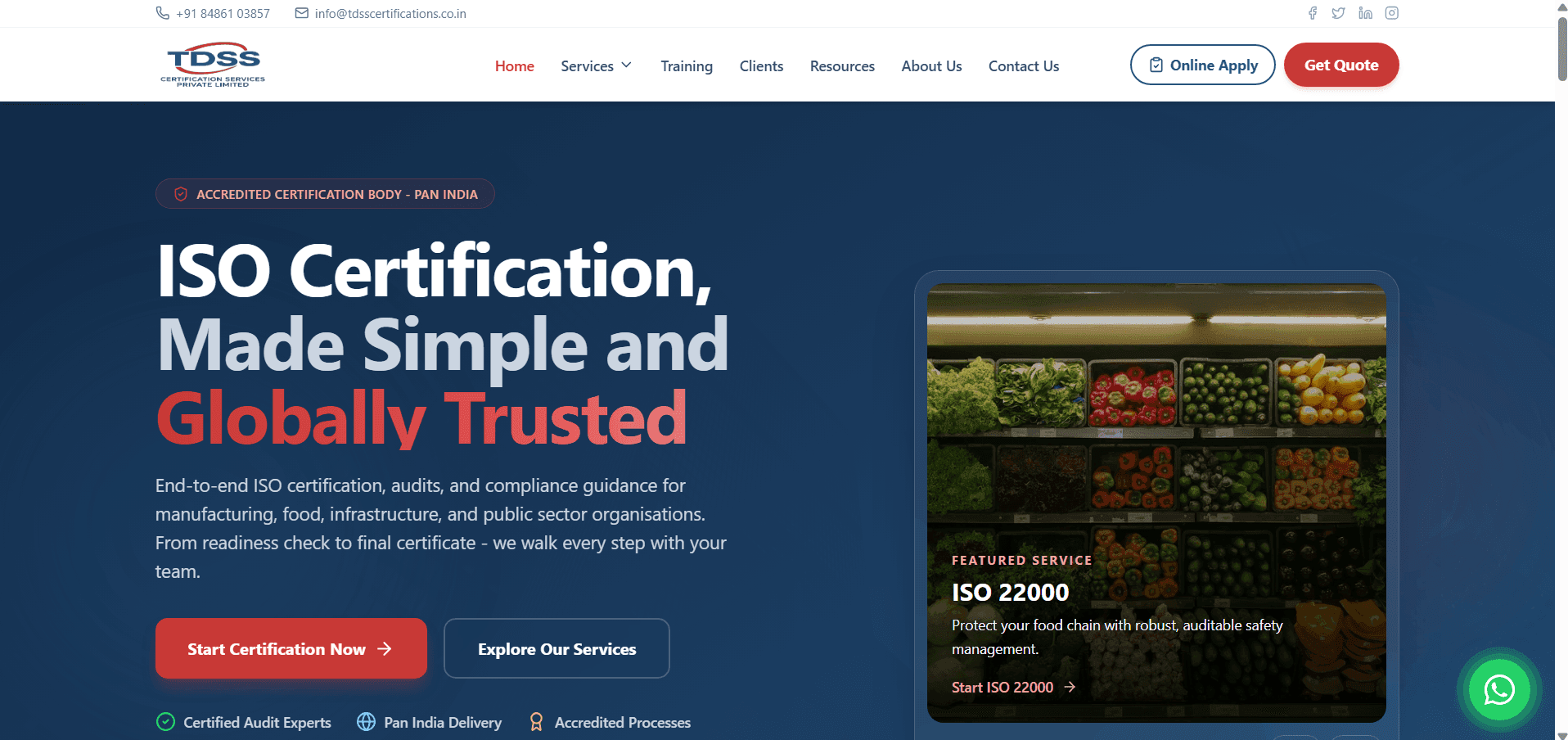
Dedicated Service Pages: Each ISO standard gets its own page — ISO 9001 Quality Management, ISO 22000 Food Safety, General ISO Certification, and the full Audit Process. This isn't just good UX; it's SEO architecture. A business searching for "ISO 22000 certification consultants" should land on a page that speaks specifically to food safety certification, not a generic homepage. Each service page is built around the buyer's decision-making journey: what the standard is, who needs it, what the process looks like, and why TDSS is the right choice.
Premium Corporate UI: The design is deliberately premium and institutional — clean typography, structured layouts, and trust signals prominent (accreditation references, process clarity, team credibility). In a market where many competitors look amateur, looking credible is a conversion lever.
Legal & Process Pages: Complaint Policy and Appeal Process pages — built to meet the procedural requirements of certification body standards, and accessible to clients through the site. These aren't afterthoughts; they're part of what makes TDSS look like a properly run certification body.
Conversion-Focused Structure: Every service page flows toward a primary action — enquire, apply, or get a quote. CTAs are placed at the natural decision points in the scroll: after understanding the standard, after reading the process, and before leaving the page.
Lead & Application Management System
This is where the project moved beyond "website" into "business infrastructure."
Supabase Backend: All lead data, application submissions, complaints, and appeals write to a Supabase PostgreSQL database. Structured, queryable, persistent. The data doesn't live in someone's email inbox — it lives in a system.
Admin Dashboard with Secure Login: A full CRM-style admin interface, protected by Supabase Auth. The TDSS team logs in to see a real-time view of:
- All incoming enquiries and leads
- Submitted certification applications with full applicant details
- Complaints and appeals with status tracking
- Filterable by status, date, and application type
No more spreadsheets. No more "which email did that application come in on?" The entire business pipeline is visible in one interface.
Status Management System: Applications move through a structured workflow — Pending → Under Review → Approved / Rejected. Each status change is tracked with a timestamp. The team updates status in the dashboard; the applicant is notified automatically. This is how a professional certification body should operate.
Automated Email Notifications via Resend: Every meaningful event in the pipeline triggers an email:
- New lead inquiry → instant admin alert with full lead details
- Application submitted → confirmation to applicant + admin notification
- Status update (Under Review, Approved, Rejected) → automated email to applicant
No manual chasing, no missed follow-ups. The system communicates on behalf of the team automatically.
Performance & Reliability Layer
Redis via Upstash: A Redis caching and queue layer was implemented for performance-critical operations — rapid data retrieval for the admin dashboard, request deduplication, and background task management. On a platform where an admin needs to review 50 applications quickly, response time matters.
Cron Jobs for Backend Uptime: Scheduled cron jobs run at regular intervals to prevent Supabase and backend services from entering cold-start sleep mode. This ensures that a lead submitting a form at any hour — midnight on a Sunday, 6am on a holiday — hits a live, responsive backend. Zero missed leads from infrastructure downtime.
Conversion & Tracking Setup
The entire tracking architecture was designed before a single page was built. In compliance services, the sales cycle spans weeks — understanding the full funnel is critical to knowing where to invest.
Google Tag Manager (GTM): All tracking events are managed through a single GTM container. Modifiable without code deployments, auditable, and scalable as the marketing strategy evolves.
Google Analytics 4 (GA4): Full custom event tracking implemented via a structured dataLayer architecture:
- form_submit_attempt — fires when a visitor clicks the submit button. Measures intent even before form validation completes.
- form_submit_success — fires on confirmed, successful form submission. The primary conversion event.
- form_submit_error — fires when a submission fails. Surfaces form UX problems and technical errors before they silently kill conversions.
- phone_click — fires on every click of the business phone number. In B2B services, a significant portion of real conversions happen by phone — without this event, you're missing a major part of the funnel.
- whatsapp_click — fires on WhatsApp CTA interactions. For the Indian B2B market, WhatsApp is a primary business communication channel. Every click is a warm lead signal.
- thank_you_page_view — fires when a visitor reaches the post-submission confirmation page. Used as the primary conversion event for Google Ads optimisation.
Google Ads Conversion Readiness: The thank_you_page_view event is connected as a conversion action in Google Ads. Smart Bidding has clean conversion data from Day 1 — the moment any paid campaign goes live, the algorithm can optimise for actual leads, not just page visits.
Why This Event Architecture Matters: Most agency setups track "form submitted" and call it done. Tracking attempts and errors separately reveals friction in the funnel that would otherwise be invisible. If 200 people attempt to submit the ISO 9001 enquiry form but only 140 succeed, that 30% drop-off is a fixable problem — one you can only see with this level of event granularity.
Technology Stack
- Frontend: Next.js 14 (App Router) — fast, SEO-friendly, server-rendered
- Hosting: Vercel (edge deployment, automatic scaling)
- Backend: Supabase (PostgreSQL database + Row-Level Security + Auth)
- Cache / Queue: Redis via Upstash (performance optimisation + background tasks)
- Email Automation: Resend API (lead alerts + applicant status notifications)
- Analytics: Google Tag Manager + Google Analytics 4
- Tracking Events: form_submit_attempt, form_submit_success, form_submit_error, phone_click, whatsapp_click, thank_you_page_view
- Ads Readiness: Google Ads conversion action via GTM / GA4
- Version Control: GitHub
Results & Impact
The outcomes here aren't invented numbers. They're the structural changes that move the needle:
Structured lead capture system operational. Every inquiry now enters a managed database with full contact details, service interest, and timestamp. The sales team has a queue, not a chaos of emails. No lead is missed.
Full application pipeline managed digitally. ISO certification applications move from submission to outcome through a tracked, status-managed workflow. The team has visibility. Applicants receive automated communications at each stage. The process looks — and operates — professionally.
Improved tracking visibility across the funnel. Six distinct conversion events now fire across the user journey. The team can see where visitors engage, where they hesitate, and where they convert. Form error tracking alone typically surfaces conversion blockers that were previously invisible.
Faster performance than the previous setup. Next.js on Vercel's edge network, Redis caching for the admin layer, and optimised asset delivery. The site performs well on both desktop and mobile, and the admin dashboard is snappy — critical for a team reviewing applications throughout the day.
Ads-ready infrastructure in place. The moment TDSS decides to run Google Ads or Meta Ads, conversion tracking is configured and live. There's no "we need to set up tracking first" delay. The system is ready to scale.
Key Takeaways
Certification services clients are evaluating trust, competence, and professionalism before they ever pick up the phone. The website has to communicate all three instantly.
But trust signals in the UI are only half the equation. The system behind the website — how leads are captured, how applications are tracked, how status updates are communicated, how the team manages their pipeline — is what makes the difference between a credible operation and a company that looks good but works like it's 2010.
TDSS now has both: a premium public-facing website and a proper operational backbone. New leads are captured and tracked. Applications are managed through a structured workflow. The team has real-time dashboard visibility. And when paid advertising begins, the tracking infrastructure is already in place to make every campaign accountable.
In professional services, the system is the service. A certification body that manages its own operations with precision is one that clients trust to certify theirs.
Want a high-converting website and lead management system for your professional services business? We build the full stack — premium website, backend infrastructure, admin tools, and tracking — so your operations are as credible as your credentials.
Talk to Sparq IT Services — let's build a system that closes clients, not just attracts them.